Cut Laser System fabricates custom polypropylene tanks for industrial process lines. Tanks are built from PP sheet and welded in our own workshop, so dimensions, compartments, connections and supports follow your project instead of a standard mould.
We have manufactured rinsing tanks, immersion tanks, electropolishing tanks, acid tanks with lids, microfiltration tanks and acid wash sinks — see the references below. Alongside PP we also work in polyethylene (PE) and PVC using the same industrial plastic welding processes, and we fabricate the stainless steel frames, grids and washing baskets that often go with them.
(PVC also fabricated)
hot-plate · extrusion · hot-gas
Industrial PP tanks built to project requirements
Each reference was manufactured for a specific customer installation. Filter by duty to see them — the dimensions, connections and accessories on your tank will be your own.
Eight tanks fabricated for specific customer installations. Dimensions, connections and accessories are decided per project.
Custom polypropylene tank manufacturing
Moulded tanks rarely fit an existing line. When a tank has to slot into a defined footprint, sit at a set working height, carry a filtration unit or match the pitch of a transfer system, building it from sheet is the only practical route.
Working to your project means we decide with you:
- Internal dimensions and capacity — driven by the process volume and the space available.
- Shape and compartments — single tanks, multi-compartment tanks, sinks, cascade or overflow arrangements.
- Connections — inlets, drains, overflows and the positions of any nozzles required by your pipework.
- Reinforcement and support — welded ribs, frames, feet or steel support structures fabricated alongside the tank.
- Accessories — lids, covers, splash guards, level cut-outs, pump and filter mountings.
Where a tank needs a metal frame, walkway or trolley, it is manufactured in the same workshop — see modular metal structures.
Polypropylene welding and fabrication
A fabricated tank is only as good as its welds. We carry out industrial plastic welding in-house using hot-plate, extrusion and hot-gas processes, selecting the technique that suits the joint: butt joints in the shell, corner and reinforcement welds, and welded-on fittings.
Working the material ourselves also means the details are integrated rather than bolted on afterwards — reinforcing ribs, support profiles, lids and mountings are welded as part of the tank. The same capability covers polyethylene (PE) and PVC assemblies and technical components that are not tanks at all.
Every assembly is checked for leak-tightness and finish before it leaves the workshop.
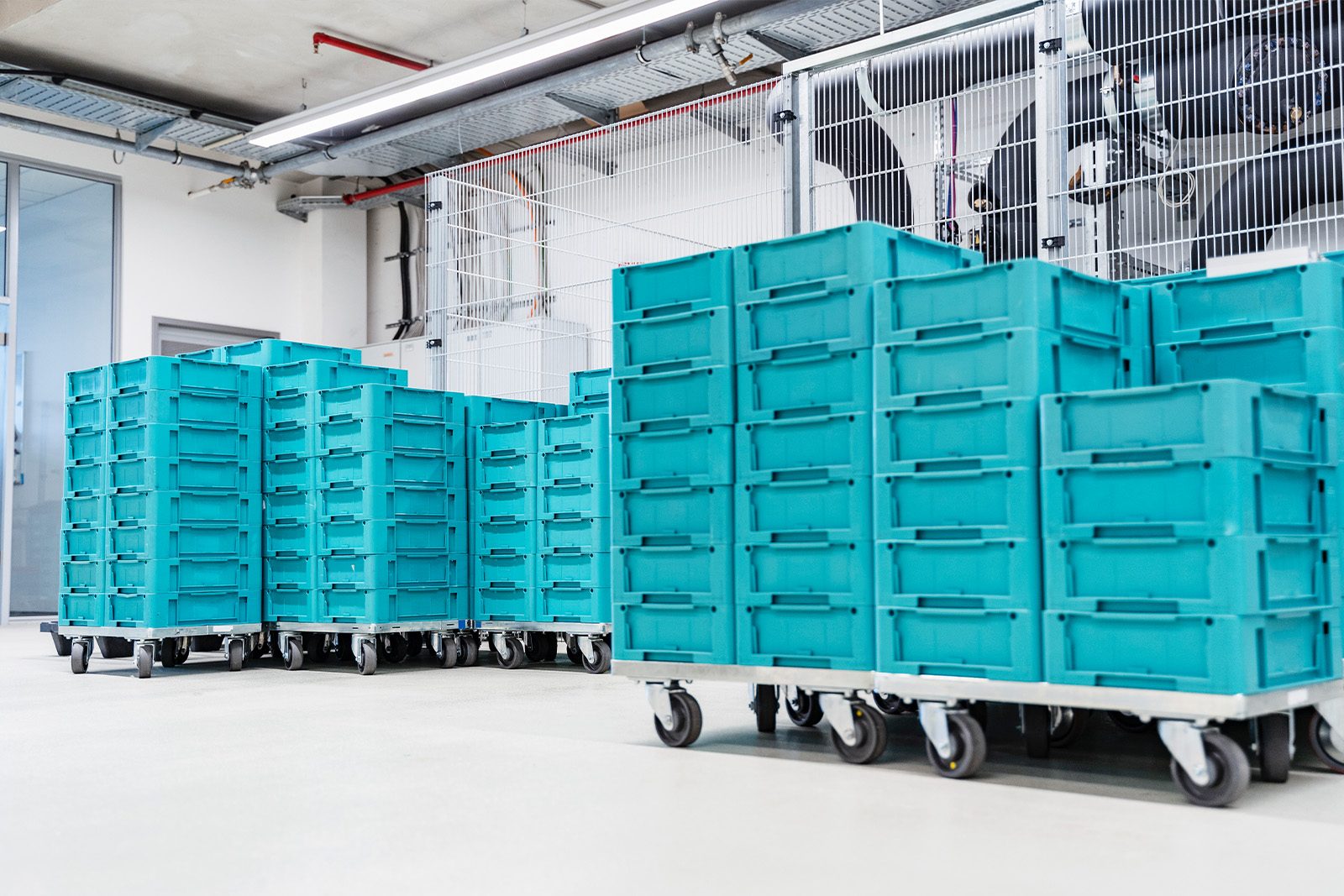
Why polypropylene is used for industrial tanks
PP has become a default choice for process tanks in cleaning, plating and treatment lines, for a few practical reasons.
- Chemical behaviour. PP resists a wide range of aqueous industrial solutions that would attack unprotected steel. Suitability still has to be confirmed for the specific medium, concentration and temperature.
- Weight. A PP tank is substantially lighter than a comparable steel tank, which simplifies installation, support structures and any later relocation.
- Fabrication freedom. Because tanks are welded from sheet, the format is not limited by tooling — an unusual footprint costs no more to produce than a rectangular one.
- Surface and cleanability. Welded PP gives a smooth, non-absorbent internal surface that is straightforward to clean and to repair locally if damaged.
- Repairability. Plastic-welded assemblies can be modified — a new nozzle, a partition, a raised wall — without replacing the tank.
A note on chemical compatibility. We deliberately do not publish a chemical resistance table. Compatibility depends on the exact medium, its concentration, the operating temperature and the duty cycle. Send those details with your enquiry and we will tell you what we can manufacture for the application, and where you should confirm compatibility with your chemical supplier.
Quality and leak-tightness control
Leak-tightness is the property a process tank is judged on, so it is verified on every assembly before delivery rather than sampled.
Welds are inspected visually, dimensions are checked against the agreed design, and the internal surface is examined for defects that would collect residue. If your quality system requires a specific inspection or documentation, tell us at enquiry stage so it can be included in the scope.
Polypropylene tanks — frequently asked questions
What is a polypropylene tank?
It is a tank fabricated from polypropylene sheet rather than moulded or metal. The sheet is cut, folded and welded into the required shape, which makes the format completely free: rectangular process tanks, sinks, compartmented tanks and tanks with integrated supports are all produced the same way.
Can PP tanks be manufactured to custom dimensions?
Yes — that is the normal case. Because tanks are fabricated from sheet, the dimensions follow the space available and the process, instead of a standard mould size.
What information do you need to quote a custom polypropylene tank?
The intended application, internal dimensions or required capacity, the medium the tank will hold, the operating temperature, any connections or nozzles required, and installation constraints such as available floor space or how the tank has to be supported. A drawing or a sketch helps, but a clear description is enough to start.
How are industrial polypropylene tanks fabricated?
Sheet is cut and prepared, panels are folded, and the joints are welded using industrial plastic welding — hot-plate, extrusion and hot-gas processes, all carried out in our own workshop. Reinforcements, supports and accessories are welded on in the same way.
Can connections, nozzles and accessories be customised?
Yes. Drains, overflows, inlets, lids, reinforcement frames and support structures are all fabricated as part of the tank. Tell us the positions and sizes required and they are built into the design.
Are polypropylene tanks suitable for chemical applications?
Polypropylene is widely used for industrial process tanks because of its resistance to many aqueous chemical solutions, but suitability always depends on the specific medium, its concentration and the operating temperature. Send us those details with your enquiry and we will confirm what we can manufacture for the application — we do not claim that every PP tank suits every chemical.
Can you manufacture a PP tank from our drawing?
Yes. We work from customer drawings, from an existing tank used as a reference, or from a specification we develop with you. Quotations are normally issued within 24 hours.
